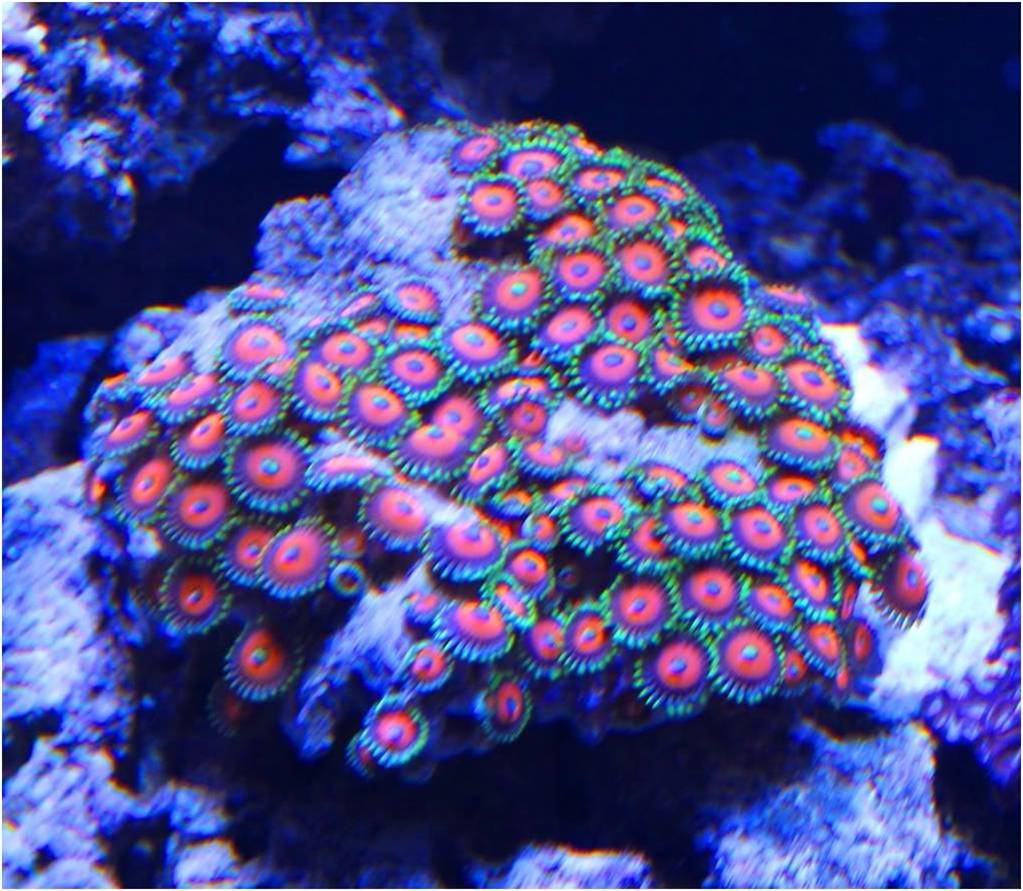
Good Corals for Beginners: Zoanthid and Palythoa
Zoanthid and Palythoa are both colonial type corals, meaning they form a colony of individual polyps all living together. They are commonly referred to as zoas and palys. As they are very similar corals, I have combined them into one article. Zoas and Palys are both very hardy soft coral placing them amount the easier to keep corals and making them a excellent choice as corals for beginners. These corals can come in some spectacular colors and color combinations, among the most amazing colors to be found in any soft coral. For these reasons, they are kept by advanced and new hobbyist alike. I have also added star polyp corals and glove polyp corals into this article as they are also colonial corals with very similar requirements and hardiness when compared to zoas and palys. The below will outline the requirements to keep these corals healthy and thriving in your tank.
Some General Guidelines for Zoas and Paly Coral Care
While they can tolerate a wider range of water parameters, this will not remove your responsibility to provide the best water conditions that you can as detailed below
Salinity: 1.025 to 1.027
Temp.: 77 to 79 degrees F.
Nitrates: below 5 ppm is best for long term health, however they tolerate much higher levels for a period of time.
Phosphates: below 0.05 ppm
Water Flow: Between moderate to low flow but not directed at the coral
Lighting: Moderate to Low. Some can handle higher levels of lighting if properly acclimated
Alkalinity (dKH), Calcium, Magnesium, and pH, all should be balance with each other as described in the below link:
https://reefaquarium.com/2012/ph-in-marine-aquariums/
As neither zoa or palys have a calcified skeleton structures, they can be more tolerant of swings in the alkalinity, calcium, and magnesium when compared to other corals. However, they will not be very tolerant to swings in PH, Temp, or salinity which is no different than any other coral or fish.
These are among the more tolerant corals to different levels of lighting. These corals contain zooxanthellae inside their body, they will be able to get most of their required nutrients through your tank lighting. This is why it is important to have the correct levels of lighting in your tank and to watch for signs that your lighting levels may not be correct. These corals can also get nutrients from the water in the form of microplankton and zooplankton and will benefit from the occasional spot feeding. They will do best when they get their needed nutrition from both the water and your tank lighting. They are not tolerant of higher flow rates. If it looks like the heads are not fully opening, try placing them in a area with lower flow.
Most corals have a natural defense mechanisms to protect themselves. Zoas and Palys have are the least aggressive when it comes to defensive abilities. Often, the opposite can be said about them. They can quite frequently become damaged and even start losing heads when they fall victim to another coral’s sting or exposed to those toxins. In addition, the protective slime like coating that is on the zoas and palys are a favorite delicacy among the “coral nipping” fish. The corals typically dies when a fish removes the outer slim coating from the coral.
Some types of zoas and palys can grow so fast that I would even state they are a invasive coral that can take you’re your tank it your let them. Zoas and palys do best when attached to the rocks. There should a adequate space place between them and other corals depending on the other coral’s requirements. The slime coating on some palys can also be toxic to humans so please, handle these corals with care.
Some Examples of Zoas and Palys
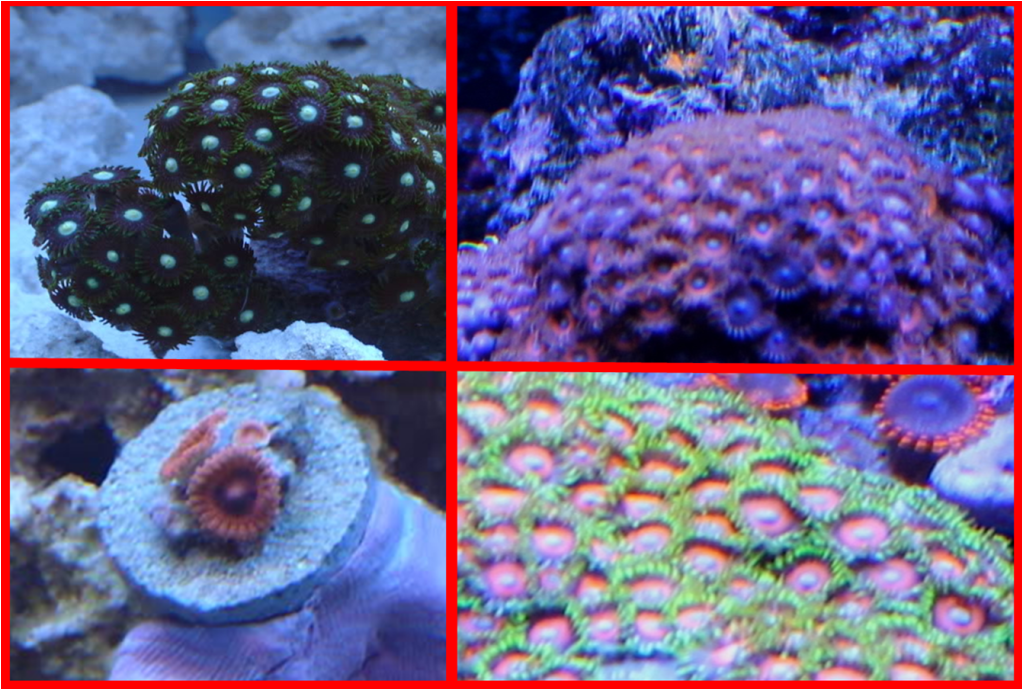
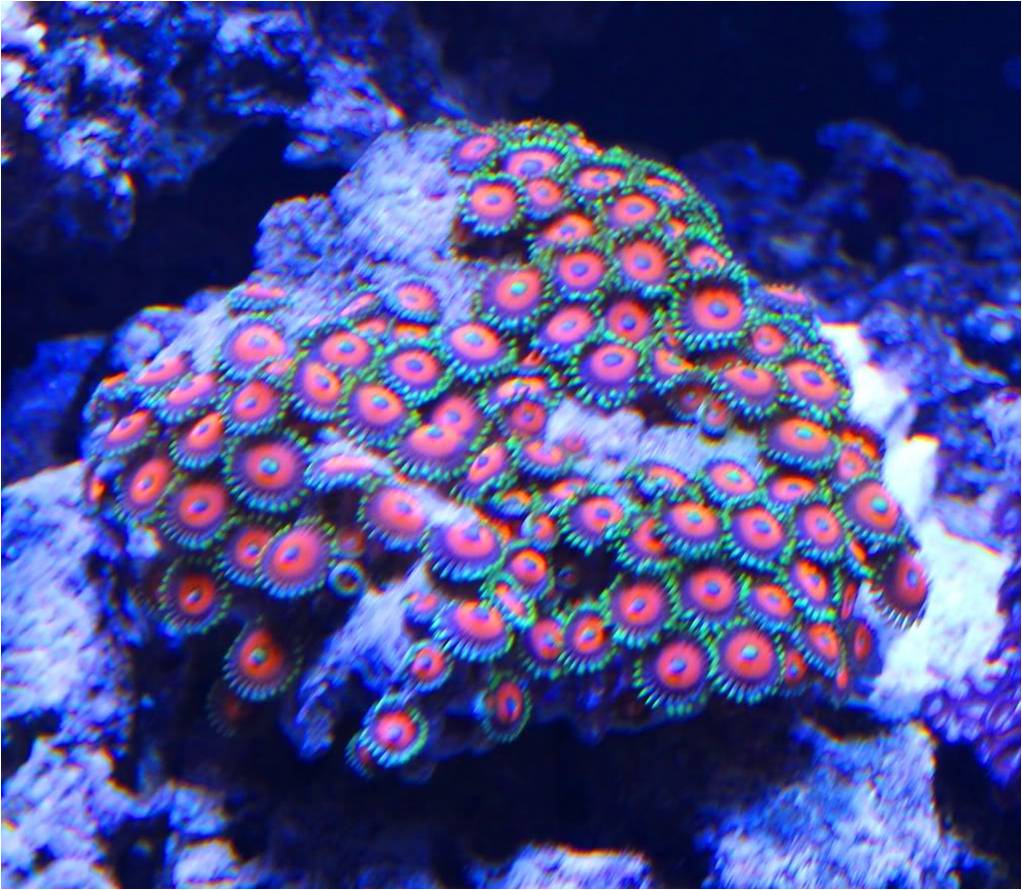
Zoanthideas
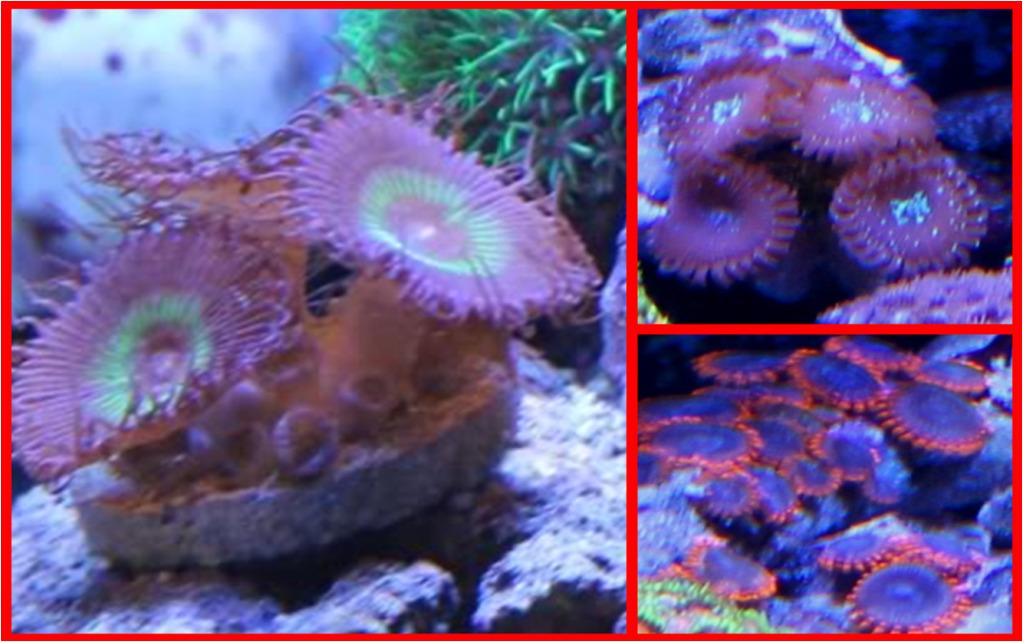
These corals come in a very wide range of colors and color combinations. Some zoas can have up to three different colors on them: one around the outer edge of the head, one on the head, and a third in the center of the head. Zoas stay fairly small in size (less than 1 inch) but the colony can easily grow and expand. You have to be very careful with the compatibility of reef safe fish and zoas in the same tank. These will typically be the first corals to suffer from a coral nipping fish. The pictures above are of a few different zoas in my tanks.
Palythoas
As with zoas, palys can come in a wide range of colors and color combinations. While the heads can range in size from ½ to 2 inches, the colony can grow at a fairly fast pace. The slime coating on some palys are among the most toxic to humans so please, handle these corals with extra care. The above pictures are of a few palys that I have in my tanks
Clove Polyps (Clavularia sp)
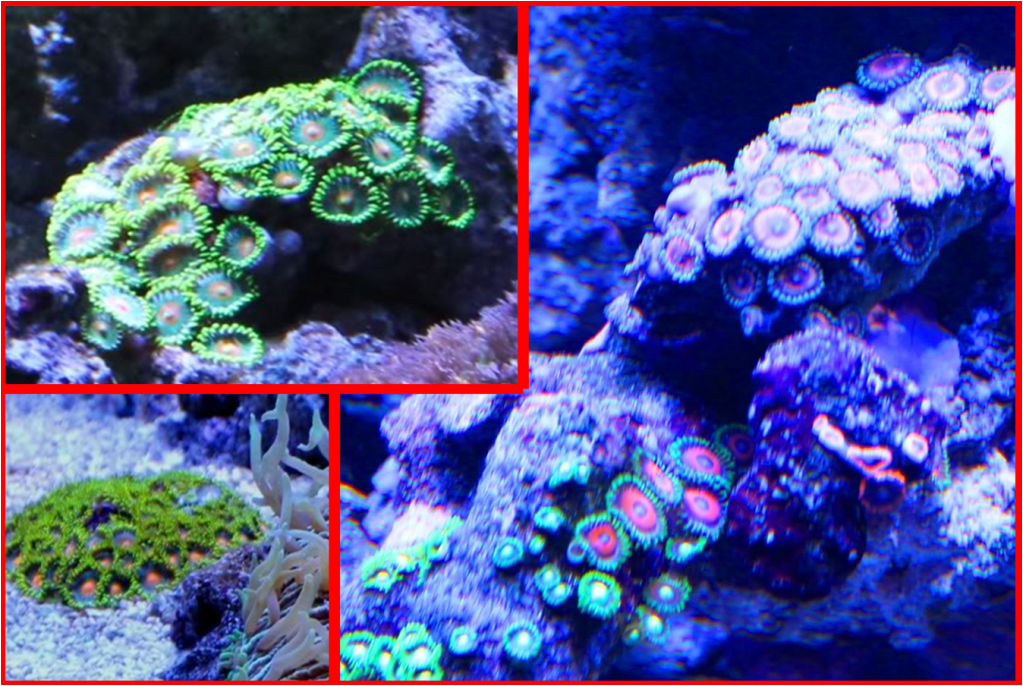
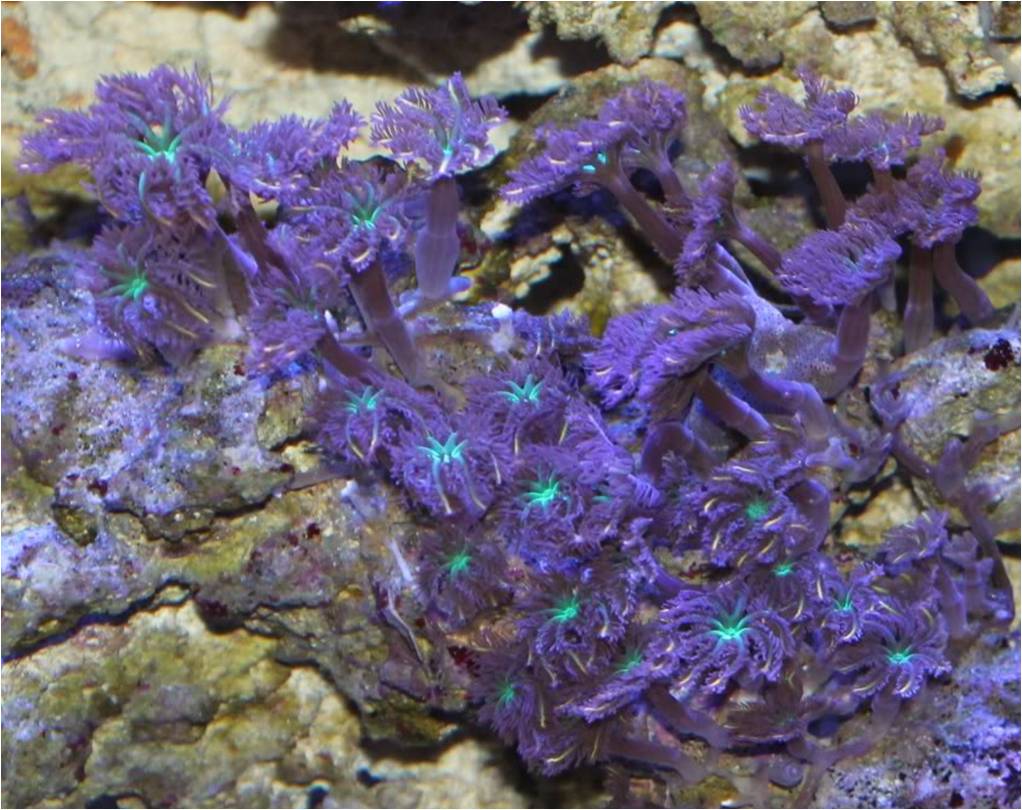
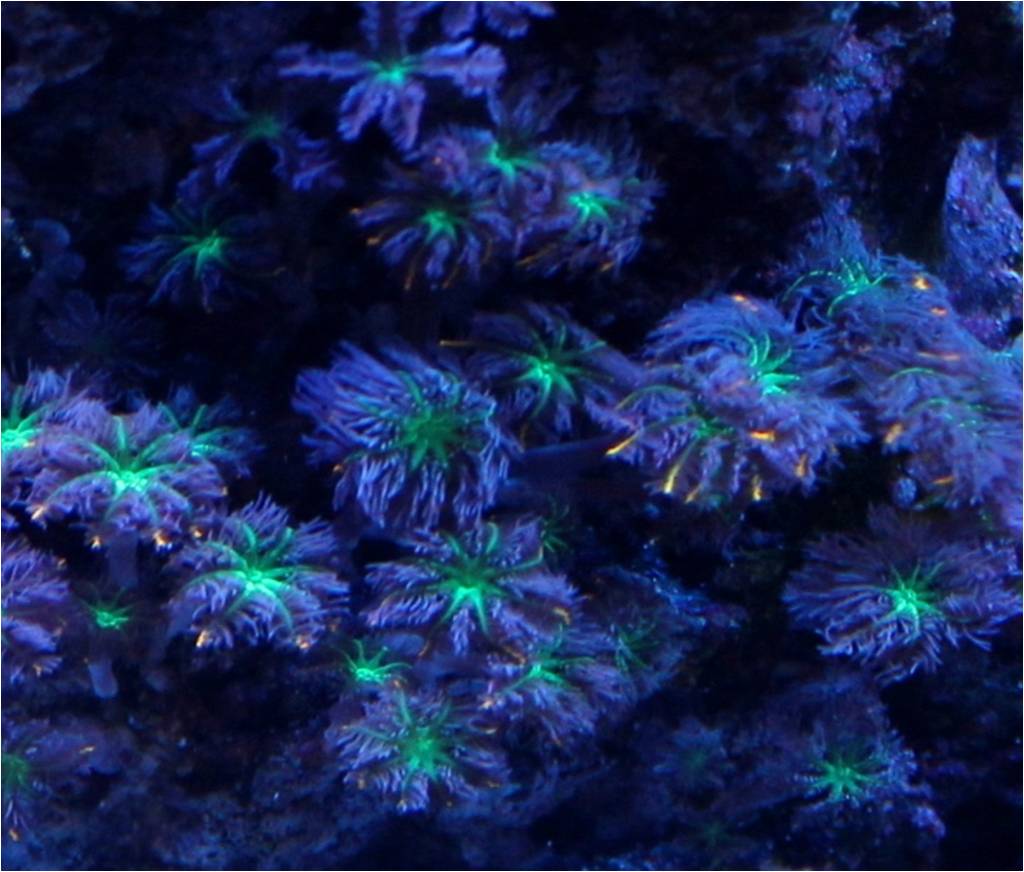
While these are not a zoa or paly, I have included them here as they have the same requirements as zoas and palys, and can often mistakenly assumed to be a type of paly. They only get to about 2 to 3 inches in height and have a head size of about ½ inch. The heads can have a bright almost neon coloring to them while the tentacles branching off the heads can have a colored line running down the center of them. The heads can retract into the base of the coral making it look like a purple lumpy spot on your rocks. These are among the fastest growing corals that I have kept. When kept in the correct conditions, these corals will take over your whole tank if you allow them to grow uncontrolled. The above picture is of the clove polyps that I have in my tanks.
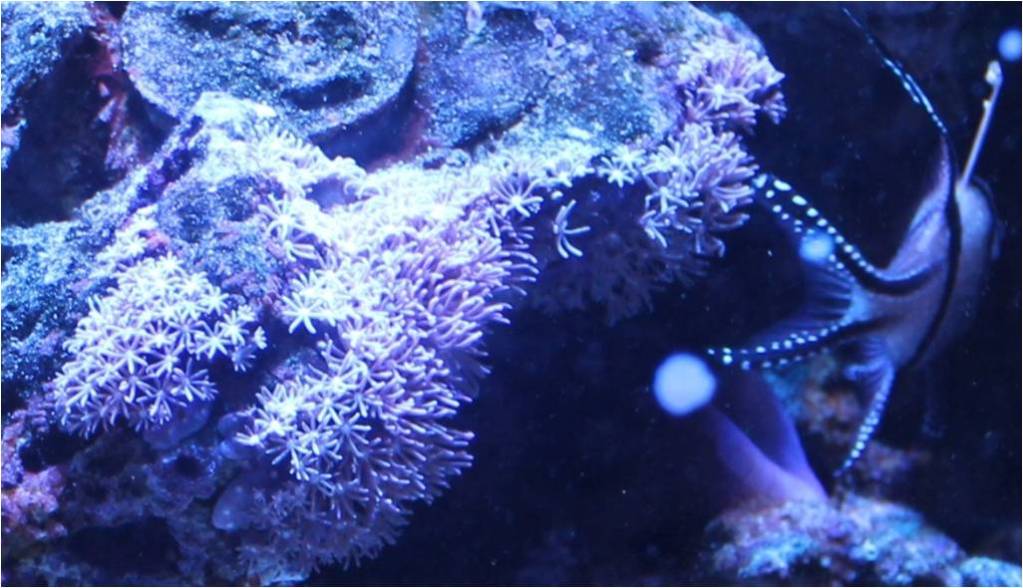
Star Polyps
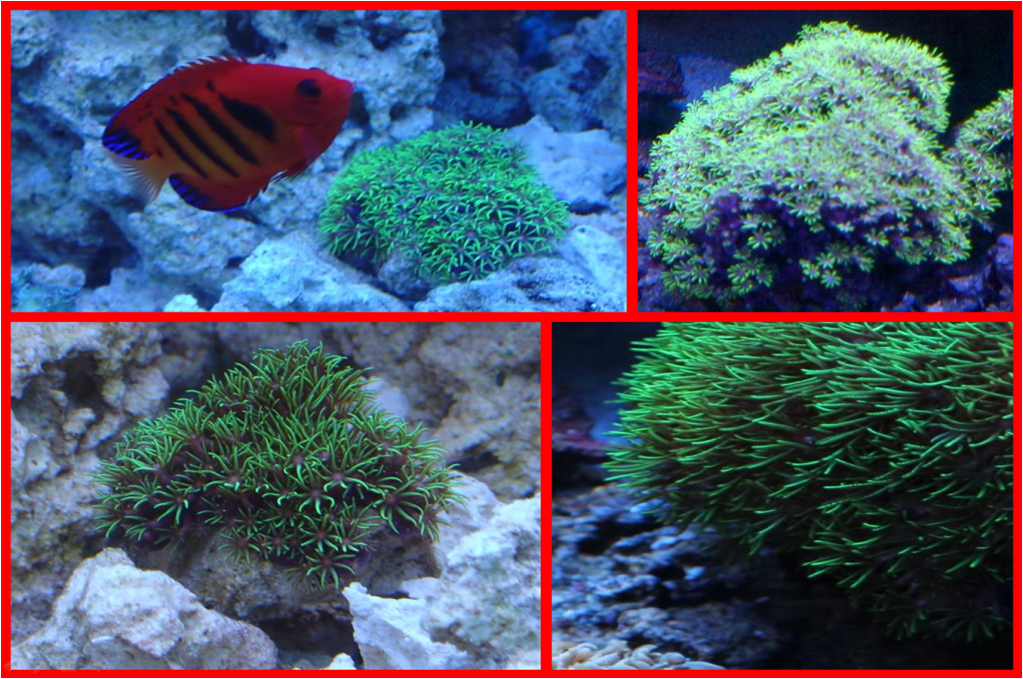
Once again, these are not a zoa or paly, I have included them here as they have the same requirements as a paly and can sometimes be mistakenly assumed to be a type of paly. These corals can grow on your rocks as well as on the sand and on the glass of your aquarium. They grow almost like a carpet of small polyps that only have a height of about ½ to 1 inch and a head size of about ¼ to ½ inch. The heads of these corals can completely retract into the base making it look like a think purple coating on your rocks. Green is the most common color to find this coral in. I have read they can be found in other colors, but I have only seen them in green and pink. The above are pics of green star polyps and pink star polyps in my tanks
Thanks Cliff for the information that you provide. You mentioned how toxic the slime coating on some palys are. I would appreciate it if you write an article on the handling of these corals or direct me to a link.
Thanks,
Terencw1962
Terencw1962, there are rubber gloves sold in on-line reef supply websites that will provide you with all the protection that you should need. Coralife is one brand that comes to mind for me right now (link below)
http://www.marinedepot.com/Coralife_Aqua_Gloves_%28One_Pair_Shoulder_Length_Protective_Gloves%29_Protective_Gloves_for_Saltwater_Aquariums-Coralife-ES09505-FIMTPG-vi.html
I have just got green star polys last weekend in my tank and the fish store said nothing about posions. I am not worried but i have notice that like twice a day they will squirt out a cloudy substance in the water is that the slim or dangerist stuff. I also have 2clown fish, one blue hippo tang, and one stawberry phuesacomis will it kill any of my fish.I keep salt at 1.021 to 1.023 ph 8.3 little nitrite tank has only be set up since new years. it is 35 gallon hex with protien skimmer,40 lbs of live rock and one power head inverts 1 feather duster, 1 candy cane shrimp and 2 star fish. is there any danger or recommondations.
Jesse: Zoas and pallys can contain a toxin called “palytoxin”. This is very toxic to people. I would suggest wearing plastic gloves if you need to handle these corals and to also use a good quality carbon in your tank to remove the palytoxin from your water.
One of the more common reasons for corals to release toxins is stress from being place too close to other corals or stress to due water quality or conditions. I would start by rasing your salinity to 1.025 to 1.026. At the depth and temp in the ocean were most of the zoas are found, the salinity is at 1.025. That might help remove some of the stress causing this
HI I RECENTLY BOUGHT SOME RED HEAD KID ZOAS ONLINE AND THEY GOT HERE WITHIN A COUPLE DAYS AND I DID THE ACCLIMATION TO A T, FOLLOWED EVERYTHING THEY SAID TO DO CORRECTLY AND DID THE 2 HOUR ACCLIMATION PERIOD AS THEY RECCOMMENDED AND THEY STILL ARE NOT OPENING UP. WHAT DOES THIS MEAN? AM I DOING SOMETHING WRONG? SHOULD I TRY SOMETHING DIFFERENT? OR ARE THEY DEAD? PLEASE HELP ME. THANKS
How did you acclimate them to you tank?
How did you acclimate them to you lighting ?
What are the parameters of your tank ?
Shipping can also be stressful on corals, taking them a few days to open
Hi cliff,
I live in the UK, as I am very new to Marine/reef keeping, some advice from you would be very much appreciated. I came across your website by chance and read your research into reef keeking.
I have a custom built cube 60gallons, my set up consists of Caribsea life Rock 40lbs,dry coral sand, the equipment consists of bubble magus protein skimmer, reef reactor containing 100grams of tropic marin Elimi phos long life.
I’ve had the system running for 4weeks just to bed in the pumps, heater, temp etc.
Last week to kick start the nitrogen cycle I added two kilos of Indonesian live rock semi cured, I’ve allowed five myself five days before I tested the parameters.
The readings I have are.. PH 8.0, Amonia 0ppm,Nitrite 0ppm,Nitrate 5.0ppm.Alkilinity I still need to test!
My questions are, when do I need to do a water change? And when can I start to add some critters? Thanks Simon
I would suggest completing water changes to maintain your ammonia and nitrites at 0ppm and to keep you nitrate levels at no more than 5ppm. At the very least, complete a 10% weekly water change to help replace trace elements keeping your set-up more stable. If you find your alkalinity, calcium, or magnesium levels depleting, I would suggest to either look into dosing supplements to maintain those levels, or completing bigger or more frequent water changes.
I would give your set-up another week or two. If the parameters remain stable to what they are now, you can start stocking your tank. Just keep in mind you should add your fish slowly over a longer period of time in order to help you to avoid any problems. Your set up is still very new and not yet as stable as a mature set-up can be.
Hi I am new to corals I am getting a rock with 10-15 heads of zoanthid I was just wondering if you could tell me if this would be invasive in a 10 gallon tank?
The speed they will grow at will depend on: water quality, flow, and lighting. Zoas can be fragged easy enough should they grow too fast
Hi Cliff . Thank you for some excellent tips on beginner corals. I’ve only ever had fish only aquariums, but would like to try some corals. This info has been invaluable.
I am glad you have found this helpful
I’ve been keeping zoas for a long time now and have actually bought a 45gal specifically to have zoa only tank and possibly a few blennys later on. ..
Great read on these specimens. Do not worry about zoas not expanding quickly. I’ve bought a colony before, split them up and placed them on either side of the tank.. The ones on the right opened up within a day the ones on left side of the in a week. (funnily enough the ones on the right starting spreading on the rock twice as fast once they decided to grow)
Patience is the key to coral keeping. I know it’s hard and you just want your tank to blossom immediately with the amount of time, money and effort spent but this does not happen (I find if you just keep buying new small corals every week or month and make them your favourite ones, the ones you started with have started growing without noticing) it’s a vicious cycle. But worth it every time you look into your tank.
Thanks for the excellent tips on keeping corals. I recently bought my first ever coral, a green star polyp which seems to be doing fine. After reading this article, I’m now quite confident to try zoas and palys.
I am glad you found the info helpful
Zoanthids and palys are supposed to be the hardiest and easiest corals for beginners. I have no luck with them in my tank. I have three fish, two spiny urchins, one mushroom, a hermit crab, one star fish and three brittle stars, I also have one salt water clam and lots of green carpet coral? not sure what its really called. Oh and two anemone.
All seem to be doing well but I cant keep zoas or palys. What am I doing wrong?
There might be some type of trace element in your water that might be too low or missing. When making your salt water, are you using tap water or RO water ? What is your water change schedule like ?
Also, what are your water parameters and how much flow is in the tank ?
I have had some zoas for the about 3 to 4 months. They are maintaining but not growing at all. I also have some palys and they are growing and spreading fast in my opinion. I also have some greenstar polyp that I scrapped off of another rock and put on a new one. It was not growing on the old and I got scared of stuff I saw on the rock. Turns out to be pineapples. Should not have done that. But on old rock and new the green star is not spreading either.
tank has been up for 2 years. Just started with zoas and stars about 5 months ago. been fowlr otherwise. Any ideas would be great. Im thinking lights.
90 gal with about 2 inch of substrate. 7 small fish. Clowns bluegreen chromis and couple other really small fish. 1 Blasto seems to be fine, but not growing. One Duncan again stable but not growing.
nitrates, nitrites zero. amonia zero
ph is 8.2; .dhk 12 I think; salinity 1.024 it goes up and down with evaporation if I leave the glass off.
I have a skimmer and two canister pumps one with the porus rocks (cant remember name) that keeps bacteria growing. Both have filters in them with no other media.
I have two 100gph circulating pumps
Lights are 1 – 48″ Current USA Fixture Orbit Marine Pro LED
and 1 – 48″ Current USA Fixture Orbit Marine
lights stay on about 8 hours and have 2 hour ramp ups on both. 8 hours is full intensity of white and blue
I would suspect this has something to do with your nitrates. I would first suggest completing another nitrate test with a different test kit to confirm your PPM leve